.svg)

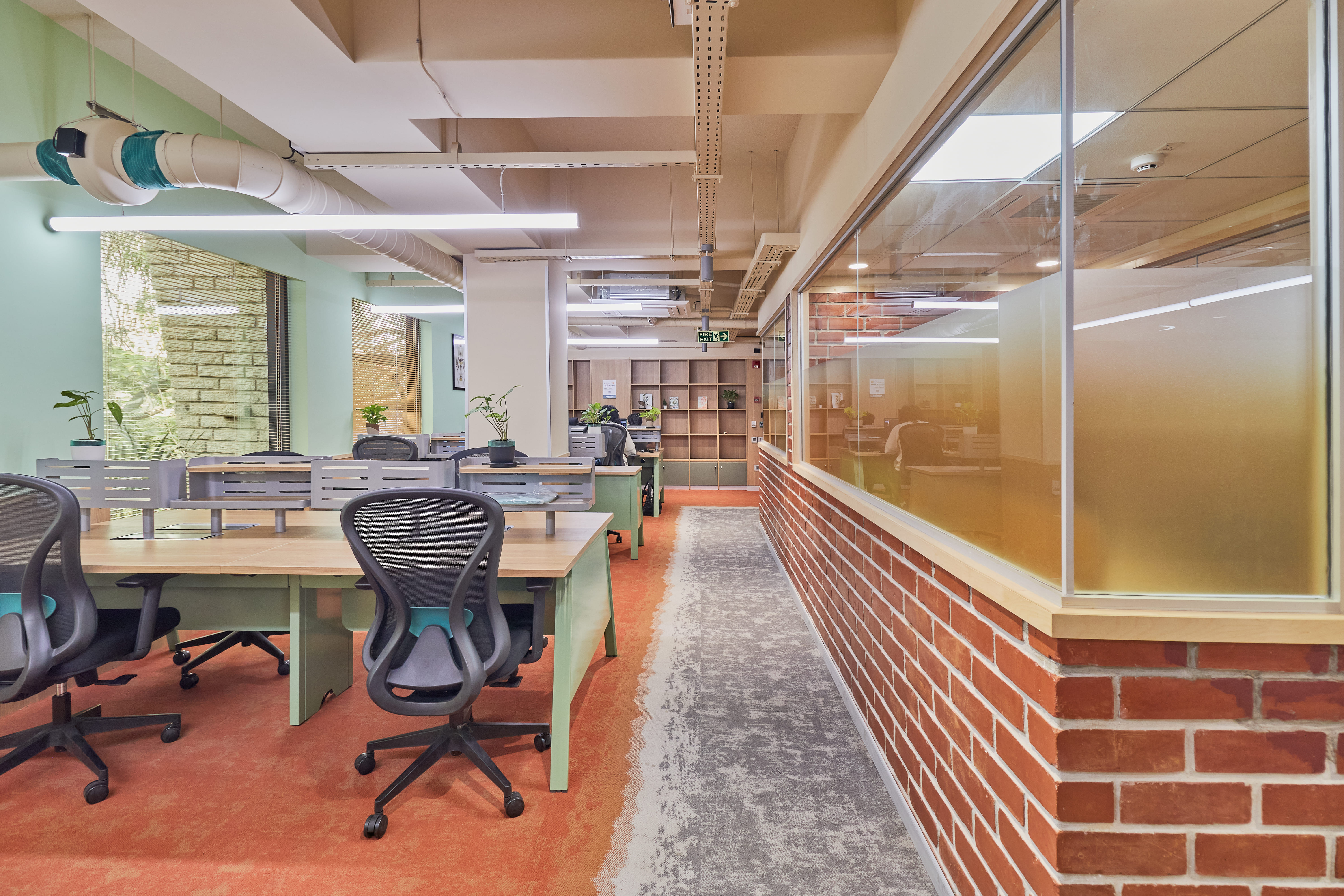
The global coworking market was valued at USD 17.43 billion in 2025 and India alone is projected to reach USD 4.53 billion by 2026. Yet the majority of that capital is flowing into spaces built for a way of working that no longer exists.
Coworking spaces in India range from high-density, amenity-heavy floors in metro hubs to quieter, design-led spaces built for focused, independent work. Pricing typically starts around ₹400 per day for a hot desk and scales to ₹15,000 or more per month for a dedicated seat in a premium environment. The right space depends not on price or location alone, but on what cognitive conditions your work actually requires.
Why the Standard Coworking Playbook Is Broken
Most coworking guides list spaces by city and price. That is the wrong framework.
The question is not where a desk costs least. The question is what the environment does to your thinking over six hours of sustained use. Noise levels, light quality, the social energy of adjacent workers. These are not soft amenities. They are the actual product.
The coworking market is projected to grow at a 15% CAGR through 2035, reaching USD 17.07 billion globally. Supply is expanding fast. Quality, however, is not keeping pace with quantity. Between January 2025 and January 2026, the national coworking footprint grew 15% to 8,973 locations. More spaces means more noise in the market, not better conditions for work.
The workers who feel this most acutely are not entry-level employees filling seats. They are founders between seed and Series A, independent consultants, small creative teams. People whose real output is judgment, taste, and direction, and who know that sustained attention is their scarcest resource.
What Actually Matters When Choosing a Coworking Space in India
Strip the comparison down to five criteria that actually predict cognitive output quality.
1. Acoustic Design
Open-plan floors built for 60-person teams have noise profiles incompatible with deep thinking. The benchmark is not silence. It is what acoustic researchers call a low-distraction sound environment, one without sudden interruptions, speakerphone conversations, or event noise bleeding into the main floor. Ask a prospective space what their noise management approach is. If the answer is "we have phone booths," that is a workaround, not a design philosophy.
2. Light Quality
Fluorescent overhead lighting is a well-documented source of cognitive fatigue. Natural light, regulated by quality blinds, is not a luxury feature. It is a condition for sustained attention. Check whether the space has windows that open or circulate fresh air, and whether artificial lighting is warm-spectrum or institutional white.
3. Community Composition
The people around you matter more than the brand on the door. The best community benefit is not the networking event. It is bumping into the right person on a Tuesday at 11am. Spaces that curate membership, rather than maximising headcount, produce the ambient seriousness that serious workers need to do their best work.
4. Flexibility Without Lock-In
Founders and lean operators face a false binary: expensive long-term leases that assume a headcount they do not yet have, or provisional-feeling spaces that quietly signal unserious operations to clients and hires alike. The right coworking space offers premium quality with no lock-in. Day passes, monthly memberships, and circuit-style access that flex with actual workflow rather than assumed headcount.
5. Wellness as Infrastructure, Not Amenity
Wellness in a workspace is not a yoga mat in the corner. It is the absence of fluorescent light, manufactured urgency, and performative busyness. A wellness-forward space is designed so that you leave feeling clearer than when you arrived. Not depleted by the environment you worked in.
The fourth wave of work has already made most coworking spaces obsolete. They were designed for coordination and activity. The AI moment has eliminated both as value drivers. What remains is judgment. And judgment requires conditions, not just a desk.
The Indian Coworking Market: A City-by-City Reality Check
India's coworking market is not uniform. Each city has a distinct character, and the right space in one city may be architecturally and socially unlike the right space in another.
Bangalore
Bangalore is India's deepest market for serious, founder-led work. The density of startups, design studios, and technology operators means the ambient energy of the right space here can be genuinely productive rather than merely active. Koramangala, in particular, is where a significant proportion of India's early-stage founder ecosystem actually lives and works. Proximity to that ecosystem is itself a form of value.
Away's Bangalore workspace in Koramangala was built for exactly this operator profile: founders and small teams who want premium conditions without locking into lease obligations that outlast their current headcount assumptions.
Vizag
Visakhapatnam is an underrated market for knowledge workers who have deliberately left the metro grind. The city has a growing independent professional class. Consultants, analysts, remote operators for distributed teams. Who need serious infrastructure without the overcrowding and cost of Bangalore or Hyderabad.
Away operates in two distinct Vizag locations. Daba Gardens and Ramnagar each carry the same design-led, wellness-forward approach, calibrated for a city where the pace is slower but the quality of thinking need not be.
Kolkata
Kolkata has long been underserved by the premium coworking segment. The city's creative and intellectual culture is deep. Design, publishing, legal, finance. Yet the coworking offer has historically defaulted to generic serviced offices rather than environments built for the quality of thought that city's professional class actually produces.
Away's Kolkata location brings the same operating philosophy east: spaces that treat quiet, light, and community composition as load-bearing design decisions rather than optional finishes.
Pricing: What You Are Actually Buying
Price transparency matters. Here is what Away's structure looks like, and what each tier is designed for.
The comparator is not other coworking passes. The comparator is the cost of cognitive degradation from the wrong environment. Which does not appear on any balance sheet but accumulates in every decision made from a position of distraction.
The Features That Separate Away From the Field
Generic coworking reviews compare amenity lists. This comparison operates at the level of environmental conditions for cognition.
Away's Stillness Rooms are the most explicit expression of an anti-noise design thesis that runs through every location. These are not phone booths or focus pods as afterthoughts. They are the architectural statement that attention is the product, and that the physical environment must be structurally on the worker's side.
The food and beverage layer, referred to as Curations rather than a café, signals a deliberate editorial taste rather than a transactional vending relationship. The coffee is good because good coffee is part of the condition for good work. Not because it photographs well for a pitch deck.
Away also offers Yoga at Away. Not as a wellness brand signal, but as a practical, timetabled offering for workers who understand that physical regulation and cognitive performance are directly connected. The space treats the whole person as the productive unit, not just the hours logged at a desk.
A good workspace should make you want to stay and know when to leave. Longer hours are a design failure, not a success metric.
How to Actually Choose the Right Coworking Space for You
Follow this decision logic rather than a ranked list
https://www.away.center/post/top-coworking-spaces-bangalore-startups
Work in a space that is structurally on your side.
Away offers day passes from ₹400 across Bangalore, Vizag, and Kolkata. No lock-in, no compromise on quality.
Frequently Asked Questions
Who is WeWork's biggest competitor in India?
WeWork competes with large-format operators like Regus, Awfis, and Spaces for the enterprise and mid-market segment in India's major metros. For smaller teams, founders, and independent knowledge workers, the more relevant competition is design-led, wellness-forward operators who prioritise cognitive environment over density and amenity count. These are structurally different products serving different professional needs.
What are the downsides of coworking spaces?
The most significant downside is noise and distraction from open-plan floors designed for high occupancy. Many coworking spaces are also built to serve diverse populations simultaneously. Sales teams, event attendees, casual drop-ins. Which creates an environment hostile to sustained, focused work. The solution is not noise-cancelling headphones; it is choosing a space whose design philosophy prioritises attention rather than treating it as expendable.
What is the future of coworking spaces in India?
The India coworking market is estimated at USD 4.53 billion in 2026 and is growing rapidly. The structural shift, however, is not just in volume. It is in what workers need. As AI handles coordination and execution tasks, the premium work that humans must perform requires environments optimised for judgment and sustained thinking. Spaces built for activity and networking are likely to commoditise; spaces built for cognitive quality are likely to appreciate in value.
How much does a coworking space in India typically cost per month?
Day passes generally start between ₹400 and ₹500 in premium spaces. Monthly hot-desk or flexible memberships typically range from ₹4,000 to ₹12,000. Dedicated seats in well-designed spaces cost approximately ₹14,000 to ₹18,000 per month. Private studio or team spaces vary significantly by city and size. The cost of a premium environment is almost always lower than the cost of a conventional office lease when factoring in fit-out, maintenance, and the lock-in risk.
Is owning a coworking space profitable?
Profitability in coworking is a function of occupancy rate, seat yield, and the ability to retain members at premium price points. High-density, low-cost spaces face significant margin pressure from the sheer cost of real estate in Indian metros. Design-led, wellness-forward operators who attract members willing to pay a meaningful premium for cognitive environment quality have a more defensible economic position. Member retention is higher when the product genuinely improves work output.
Can a small team of 2 to 5 people use a coworking space effectively?
Small teams are often the ideal coworking demographic. Large enough to need infrastructure and community, small enough to be genuinely agile about where and how they work. The key requirement is a space that offers both collaborative areas and quiet zones, so the team can work in proximity without forcing constant interaction. Studio memberships and dedicated desk configurations in well-designed spaces serve small teams far better than a conventional office lease, with no headcount commitment built into the contract.
.jpg)
.png)