.svg)

Most coworking spaces in Koramangala will sell you a seat. Very few are designed for the kind of work that actually happens in a founder's head.
Away in Koramangala is a quiet coworking space with private meeting rooms, Stillness Rooms, and a sensory environment calibrated for founders and small teams doing strategic, creative, and client-facing work. Memberships start at flexible daily and monthly tiers. If you need a workspace that protects your thinking rather than interrupting it, this is where that conversation starts.
What "Quiet" Actually Means in a Koramangala Coworking Context
Most spaces that advertise quiet are simply less loud than a WeWork floor on a Tuesday morning.
That is not the same thing as a workspace designed for quiet. One reduces decibels. The other makes a deliberate architectural and operational commitment: to airflow, to material, to the acoustic logic of how sound moves through a room, and to the social norms that govern who can do what, where.
According to Archie's 2026 coworking industry report, the global coworking market now counts over 9,100 active locations in the US alone, a 3.2% rise in a single quarter. In Koramangala specifically, the options have multiplied sharply. Flexo, 91Springboard, Indiqube, OYO Workflo, and a dozen more all compete within a few square kilometres of each other.
What they share: a density bias. More seats, more memberships, more revenue per square foot. What that optimisation systematically trades away is the quality of the cognitive environment for the person sitting inside it.
Away's position on this is specific. The coworking industry has spent a decade perfecting real estate economics and neglected the actual experience of thinking inside these buildings. Sensory overhead, that background tax of noise, visual busyness, and performative energy, is not a soft problem. It is a decision quality problem.
The Koramangala Coworking Market: What You Are Actually Choosing Between
Koramangala's coworking landscape is wide, but the distinctions that matter are sharper than most listicles admit.
At one end: large-format operators like WeWork and Indiqube, structured around enterprise contracts, 450-plus seat floors, and the open-plan energy that suits sales teams on a sprint. Meeting rooms at these spaces are transactional additions, priced typically between ₹250 per hour for a 4-seater to over ₹5,000 per hour for larger boardroom configurations, per aggregator data from Flexo.
At the other end: budget flex-desking operations that offer low monthly rates (₹6,000 to ₹6,500 per month as a common floor in the area, per platforms like Qdesq) with correspondingly thin infrastructure. Good for a freelancer on a deadline. Not calibrated for a five-person founding team preparing a Series A pitch.
The gap between those two ends is where Away operates. Not a stripped-down enterprise product. Not a noisy value-option. A space designed around the specific texture of judgment work: the long, uninterrupted stretches of thinking, the client meetings that need a room that signals quality, and the ambient environment that makes both possible.
The next competitive advantage for a small team is not a bigger headcount or a longer workday. It is the quality of decisions made inside a given physical environment. That is not a wellness platitude. It is an architectural question.
What Away in Koramangala Actually Offers
Away's Bangalore location in Koramangala is built around a single premise: the workspace should make good thinking easier, not harder.
The specific infrastructure that follows from that premise:
- Stillness Rooms: Away's proprietary quiet zones. Not just a phone booth or a glass pod on a busy floor. Dedicated decompression and deep-focus spaces with material, light, and acoustic logic behind them.
- Private meeting rooms: Designed for client presentations and investor conversations, not just internal standups. The room signals something about the team that uses it.
- Studios: Private, team-scale workspaces for 2 to 25-person teams. The language is deliberate. A studio evokes creative work. A corporate tenancy does not.
- Stations: Fixed-but-not-owned desks. Permanence without a 12-month lease commitment. The middle ground between drifting and committing.
- Drift access: Fluid, day-pass-style membership for operators who move between cities or need workspace without a long-term anchor.
Away also integrates wellness structurally, not as an amenity bolt-on. Yoga at Away is embedded into the weekly rhythm of the space. Natural light, curated material palettes, and airflow are treated as design decisions with functional consequences, not decorative choices.
Meeting Rooms That Actually Work for Client Meetings
A meeting room is not just a room. It is the first environmental signal your client reads about your company.
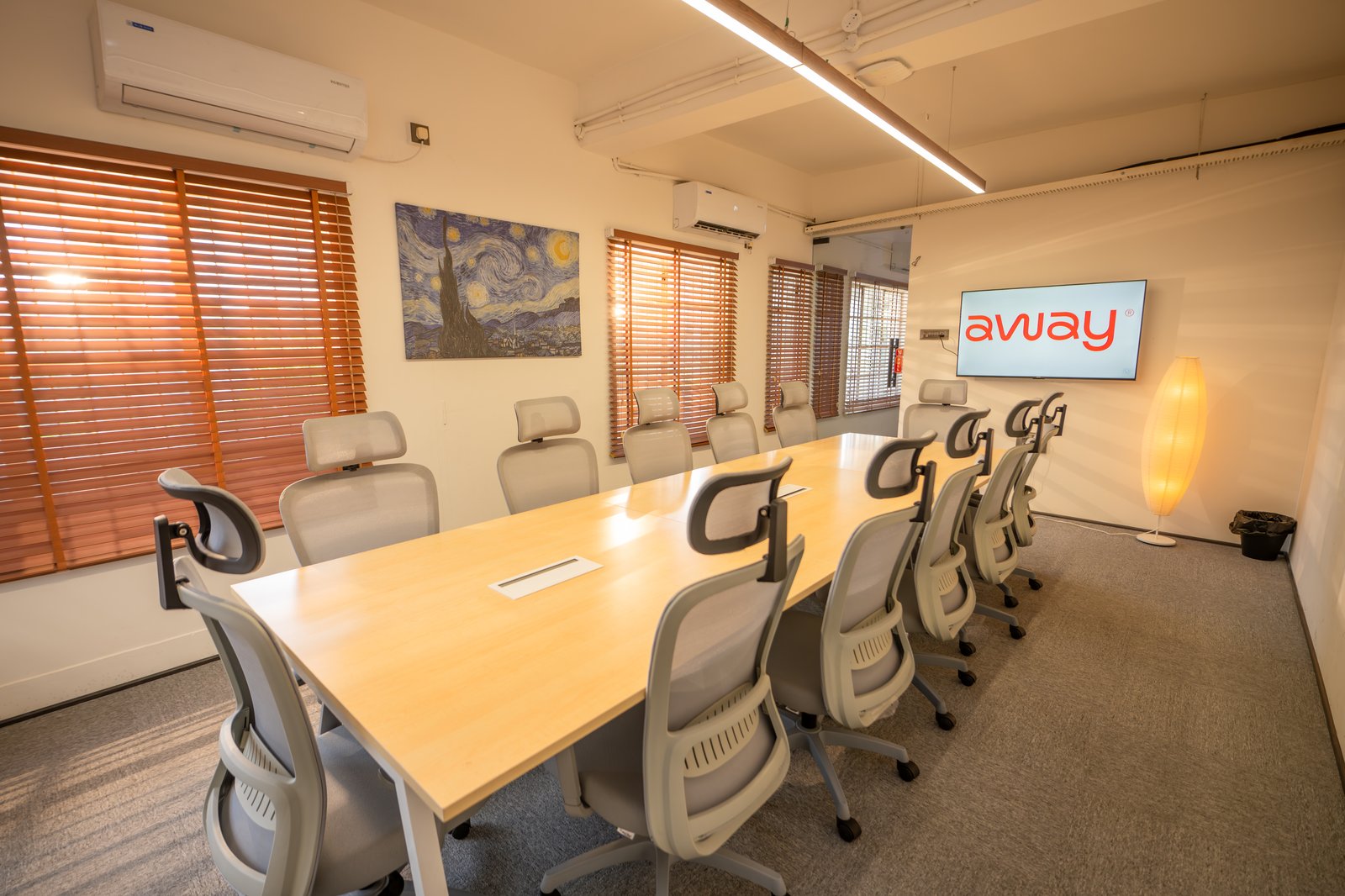
In most coworking spaces in Koramangala, meeting rooms are glass boxes inserted into an open-plan floor. The conversations inside them are partially visible, occasionally audible, and surrounded by the energy of a 200-person workspace in motion. That environment is fine for an internal retrospective. It is the wrong signal for a partnership discussion or a board-level conversation.
Away's meeting infrastructure is designed with the specific use case of the founder or small-team operator in mind: someone who brings clients and collaborators into a space that needs to project considered, serious work. Not corporate theatre. Not startup chaos. Considered work.
If you need to host a client presentation, a pitch rehearsal, or a strategy session without the ambient noise and visual distraction of a large coworking floor, Away's rooms are bookable on demand. You can book on demand through Away's platform without a long-term membership commitment if your need is occasional.
For Teams Scaling Between Two and Twenty-Five People
The administrative burden of small-team infrastructure is underestimated by almost everyone who hasn't managed it.
A GST-registered address, a room for six people that doesn't require a 12-month lease, a space that can absorb two new hires without a fit-out project: these are the specific, unglamorous needs of a team at the 5-to-20 person stage. Most workspace solutions either over-commit or under-deliver.
Away's Studio model is built for this. A team can occupy a private workspace that scales with them, without the overhead of managing a standalone office or the cognitive friction of a hot-desking setup that provides no continuity or permanence.
For teams that want to understand the full infrastructure offer, including custom-managed configurations, Away's Managed Office model extends into design-build-manage territory for teams that want a fully designed private environment under the Away philosophy without the operational burden of running it themselves.
The fourth wave of work rewards intentional environments. Where you work is a decision with real cognitive and strategic consequences, not a logistical afterthought.
The Sensory Environment as a Design Principle, Not a Feature List
The coworking industry's response to wellness has been a foosball table and a kombucha tap.
Away's response is structural. Sunlight is managed intentionally, not incidentally. Material choices are made with texture and calm in mind. Airflow is considered. The social norms of the space, what happens in which area and at what volume, are embedded in the architecture itself, not enforced by signage after the fact.
This matters because the coworking conversation in 2026 has matured past the amenity checklist. The founders, strategists, and small-team operators who are the most important unit of the modern knowledge economy have tried the open-plan coworking model. Many found it effective for certain kinds of work and actively counterproductive for others.
The work that is hardest to do in a buzzing open-plan environment is precisely the work that matters most at the founding stage: long-form thinking, strategic synthesis, product direction, investor narrative. Away is designed specifically for that category of work.
Work in a space designed for the thinking you actually need to do.
Away Koramangala offers quiet desks, private meeting rooms, and Stillness Rooms for founders and small teams who need their environment to work for them.
Get Started →Frequently Asked Questions
How much does a coworking space in Koramangala cost per month?
Pricing in Koramangala ranges significantly by operator and membership type. Budget hot-desking options start around ₹6,000 to ₹6,500 per month at spaces like those listed on Qdesq. Mid-tier dedicated desk memberships and private studio configurations sit higher, reflecting the infrastructure and environment on offer. Away's pricing is available directly through its booking platform. The more relevant question is what the environment is actually worth in terms of the work you can do inside it.
How much does it cost to book a meeting room at a coworking space in Koramangala?
Meeting room pricing in Koramangala typically ranges from ₹250 per hour for a 4-seater to over ₹5,000 per hour for larger boardroom configurations, based on aggregated data from platforms like Flexo. Rates vary by space quality, room size, and included services such as AV equipment and catering. Away's meeting rooms are bookable on demand through its platform.
Why do coworking spaces fail?
Most coworking failures trace back to one of two causes. The first is occupancy over experience: spaces that optimise for density and per-seat yield until the environment becomes counterproductive for the people inside it. The second is a mismatch between the type of member the space attracts and the type of work that member actually needs to do. A high-energy open-plan floor works for certain roles and actively harms others. Spaces that never resolve this tension lose their most valuable members first.
Who are WeWork's biggest competitors in Bangalore?
In Bangalore's coworking market, WeWork faces competition across different segments. Large-format operators like Indiqube and 91Springboard compete on scale and enterprise infrastructure. Away competes on an entirely different axis: the cognitive and sensory quality of the environment for founders and small teams doing judgment-intensive work. These are not the same product dressed differently. They are designed for fundamentally different modes of work.
Is Away in Koramangala suitable for a small team of five to ten people?
Yes. Away's Studio model is specifically designed for teams in the 2-to-25 person range who need private, permanent workspace without the commitment of a standalone office lease. It provides the team continuity of a fixed space with the operational simplicity of a managed environment. Meeting rooms are available for client and investor meetings without requiring a separate booking arrangement or a separate venue.
What is a Stillness Room and which Away locations have one?
A Stillness Room is Away's proprietary term for a dedicated quiet and decompression space within the workspace. Unlike a standard phone booth or a glass pod placed inside an open-plan floor, a Stillness Room is designed with acoustic, material, and lighting principles that make it genuinely restorative for deep focus or mental reset. Away's Bangalore location in Koramangala includes this as part of its core environment, not as an optional add-on.
.png)
.jpg)