.svg)

Bangalore's managed office market has crossed USD 3.98 billion in India-wide flexible space value for 2025, yet the majority of workers leaving these spaces at 6pm report feeling more depleted than they did walking in.
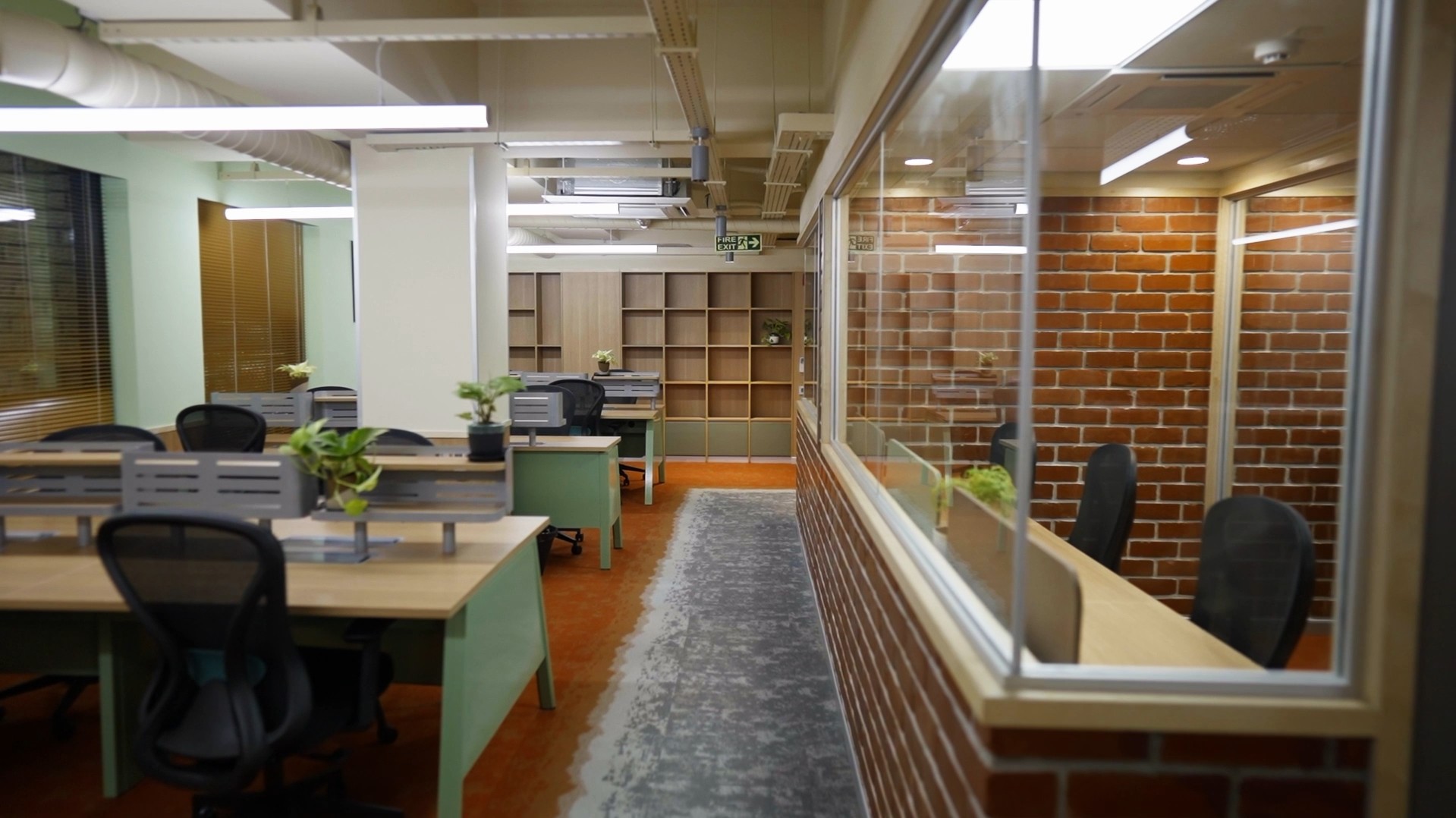
A managed office space in Bangalore is a fully fitted, operationally run workspace where the provider handles design, infrastructure, and day-to-day management. Freeing occupants to focus entirely on their work. The best managed offices go further: they treat the physical environment as an active input into thinking quality, not merely a facility to occupy. away's managed office in Koramangala, Bangalore, is built on exactly this premise.
That distinction. Between a managed office that services you and one that actually supports your best thinking. Is the one most providers would prefer you didn't ask about.
What "Managed" Actually Means (And What It Doesn't)
The word is doing a lot of work across Bangalore's flex space market, and not all of it honestly.
At its most basic, managed office means someone else handles the lease, fit-out, housekeeping, internet, and utilities. You show up; the desk is there. That much, most providers in the city deliver competently. Smartworks, Awfis, IndiQube, BuzzWorks. The operational basics are increasingly standardised across the segment.
Where the category fractures is intent. Most managed offices were designed around a single metric: seats per square foot. The layout decisions, the acoustic choices, the lighting temperature, the common area configuration. All of it optimised for occupancy, not for the quality of thought produced inside.
This matters because the work that happens in a managed office today is fundamentally different from the work that happened there five years ago. India's coworking office space market is estimated at USD 4.53 billion in 2026, growing at a pace that reflects genuine demand. But the growth of supply doesn't guarantee the growth of quality. It often produces the opposite.
The founders, consultants, and small-team operators who make up away's community in Bangalore have already cycled through the standard options. They know what 68% occupancy feels like from the inside. They left.
The Four Criteria That Actually Matter When Choosing a Managed Office
Most comparison articles rank managed offices by location, price, and amenity list. Those criteria are useful but insufficient.
1. Environmental Baseline, Not Environmental Extras
A managed office's ambient conditions. Light quality, acoustic control, air circulation, spatial rhythm. Are not the amenities. They are the product.
Cognitive performance degrades measurably in environments with high ambient noise, poor light temperature, and visual clutter. This isn't a wellness claim; it's environmental psychology that has been replicated across research contexts. The relevant question to ask any managed office operator is not "do you have a phone booth?" but "what are your acoustic targets for the open floor, and what design decisions did you make to hit them?"
Most operators cannot answer that question. away can, specifically, because every spatial decision in Koramangala was made with that kind of deliberateness. From the material palette to the placement of Stillness Rooms, which are not meditation pods added as an afterthought but purpose-designed quiet zones integrated into the spatial flow of the building.
2. The Distinction Between Managed and Serviced
These two terms are used interchangeably by most providers. They shouldn't be.
A serviced office is transactional: space is configured, handed over, and maintained. A managed office, properly understood, implies curation and ongoing care. Someone with genuine taste made specific decisions about how the environment should feel and continues to maintain those standards operationally. The difference reveals itself in the details: whether the furniture was chosen for appearance or for how it feels after six hours, whether the food offered is catered convenience or something you'd actually choose to eat, whether the spatial arrangement was planned for people or for photographs.
away's Managed Office model is built around this distinction. The design-build-manage approach means the same sensibility that informed the space's conception continues to govern its operation. It doesn't get handed off to a facilities manager with a different brief.
3. Commitment Flexibility That Doesn't Punish Serious Work
The flexible workspace market has overcorrected into ultra-short commitments that suit operators more than occupants.
Hot-desking in a space you don't know, alongside people rotating in and out, creates a baseline level of cognitive overhead that accumulates invisibly across a day. The question of commitment structure should actually be: what level of familiarity with your environment allows you to stop thinking about the environment and start thinking about your work?
away's membership structure. Including the Book on Demand option accessible through the booking platform. Is designed to let people find their own work rhythms without locking them into obligations that don't serve them. The goal is not maximum flexibility; it's the right amount of continuity for deep work to become habitual.
4. Community as Context, Not as Marketing
Every managed office in Bangalore claims community. The claim is almost always inflated.
Real community in a workspace context is not events, Slack channels, or introductions engineered by a community manager. It is the ambient quality of who is in the room with you and what they are working on. It is the absence of social pressure to perform productivity rather than actually practise it. away's members skew toward founders, operators, and independent practitioners doing the kind of work. Judgment, taste, direction. That requires a specific register of focus. That is its own form of curation, and it produces a very different room.
The fourth wave of work has made the quality of the physical environment more important, not less. What remains after automation is precisely the kind of thinking that cannot happen in a noisy, aesthetically aggressive, socially pressured room.
Why Koramangala, and Why It Matters
Location strategy in managed office decisions is usually framed as a commute question. It should also be framed as a context question.
Koramangala is Bangalore's most concentrated district for early-to-mid stage company building. The density of founders, product people, and operators is genuinely different here from the corporate corridors of Outer Ring Road or the IT campuses further east. For away's ICP, the neighbourhood itself is a contextual asset: the ecosystem proximity is real, even when you're working with your door closed.
The building in Koramangala was chosen and configured with the same intent that governs away's other locations. away's presence in Vizag at Daba Gardens and Kolkata reflects a deliberate pattern of selective expansion: one well-crafted workspace at a time, in cities where the demand for a quieter, more considered alternative to the dominant format is already visible. This is not a network effect play. It is a quality signal.
What the Standard Comparison Articles Miss
The ranked lists of "best managed offices in Bangalore" share a common methodology: photograph the lobby, list the amenities, quote the price range, assign a star rating.
None of them ask what it feels like to sit in the space at 3pm on a Thursday when the post-lunch cognitive dip arrives and the ambient noise level in the open floor is at its peak. That is the moment a managed office either earns its pricing or exposes its design decisions as purely aesthetic.
Global coworking supply is projected to reach 43,000 to 45,000 spaces by end of 2025, with the market valued at approximately USD 25 billion. Volume at that scale guarantees sameness. The managed offices that command genuine loyalty. Not just occupancy. Are the ones that made a different set of decisions at the design stage and held to them operationally.
The question to bring to any managed office evaluation is not "what do you offer?" It is: "What did you decide not to do, and why?"
away's answers to that question are specific. No forced networking events. No neon motivational typography. No food that exists to fill a checkbox. No spatial arrangement that maximises seats at the expense of the acoustic environment. These are not omissions; they are design decisions made in favour of the kind of person who finds most managed offices subtly exhausting.
Managed implies curation and care. Serviced implies transaction. The difference is not semantic. It shows up in how you feel at the end of a working day.
The Honest Assessment
away is not the right fit for every team or working style in Bangalore.
If you need a large enterprise floor plate, a co-located sales team of forty people, or the cheapest available desk in Whitefield, away is not your answer. Those needs are real and other operators serve them adequately.
away is built for the founder who has tried the standard options and found them corrosive to exactly the kind of work she needs to do. It is built for the consultant who knows his best thinking happens in a specific quality of silence. It is built for the small team that has confused busyness with productivity and wants to stop. The physical environment away has built in Koramangala is a direct response to those needs. Not a generalist product marketed at everyone.
That specificity is the point. In a market growing at 15% CAGR through 2035, the spaces that will matter are the ones that made a clear choice about who they are for. away made that choice early and has not drifted from it.
Work in a space built for your best thinking.
away's managed office in Koramangala, Bangalore is designed for founders, operators, and independent practitioners who need more than a desk.
Frequently Asked Questions
What is the difference between a managed office and a serviced office in Bangalore?
A serviced office is transactional: the provider fits out a space and hands it over with utilities and maintenance included. A managed office, properly defined, involves ongoing curation and operational care. The provider retains responsibility for how the space functions and feels, not just whether the lights are on. In practice, most Bangalore providers use the terms interchangeably. The meaningful distinction is whether design intent governs the day-to-day operation of the space or whether it was handed off at handover.
Is managed office space in Bangalore suitable for small teams and solo founders?
Yes, and it is often a stronger choice than either traditional leasing or hot-desking. Small teams and solo founders benefit most from the operational overhead being absorbed by the operator, allowing full cognitive focus on the actual work. The key qualification is whether the managed office was designed with your working style in mind. Spaces optimised for large enterprise teams can be poorly suited to the focused, self-directed work rhythms of a founder or independent consultant.
Which area of Bangalore is best for a managed office?
The answer depends on your team's composition and the nature of the work. Koramangala is the strongest choice for early-to-mid stage founders and independent operators who value proximity to the city's densest concentration of product and startup activity. Outer Ring Road and Whitefield suit enterprise teams needing large floor plates near IT campuses. For those whose work requires deep focus over client-facing presence, Koramangala's combination of neighbourhood quality and workspace environment is difficult to match.
How does away's managed office in Bangalore differ from providers like Awfis or WeWork?
Awfis competes on density and price across a large network; WeWork historically competed on brand and scale. away operates from a different premise entirely: that the quality of the physical environment is an active input into the quality of thinking, not a background condition. The design decisions at away's Koramangala location. Acoustics, spatial rhythm, material quality, food, Stillness Rooms. Reflect a specific position on how serious work happens. That position produces a different space, serving a different need.
Can I book away's Bangalore managed office without a long-term commitment?
Yes. away offers flexible access through its Book on Demand platform, alongside membership options suited to different work rhythms. The intent is not maximum flexibility for its own sake but the right level of continuity for habitual, focused work. Without locking you into obligations that don't match how you actually operate.
Is coworking and managed office space in Bangalore a growing market?
Significantly so. India's coworking office space market is estimated at USD 4.53 billion in 2026, up from USD 3.98 billion in 2025, and the global coworking market is projected to grow at 15% CAGR through 2035. Bangalore is one of the primary growth cities. The risk in a fast-growing market is that supply volume outpaces quality. Which is precisely why environmental and design standards matter more now, not less, when evaluating any managed office option.
.png)
.jpg)