On productivity: The efficiency paradox
There is something slightly misleading about the phrase “a tool that saves time.”
It tells us what happens to the task. It tells us very little about what happens to the person doing it. A founder can now investigate an unfamiliar market, work through a financial model, examine a contract, and develop a campaign in the same afternoon. They do not need to become an expert in every subject before attempting something useful. That is an extraordinary expansion of what one person can do. The qualification, though, is that other people get it too.
If everyone becomes twice as productive, the competitive baseline moves. The entrepreneur who could investigate ten opportunities can investigate fifty. The analyst produces several reports. The small company starts attempting things that once required a much larger one.
The working week does not automatically halve.
We have seen versions of this before. Email made communication cheaper and produced more email. Smartphones made us reachable everywhere and produced the expectation that we would be. Systems built around competition are remarkably good at absorbing spare capacity.
This does not make the tools less useful. A small team being able to attempt something previously unaffordable is a real gain. So is a person finding the confidence to enter a field they once considered inaccessible.
But increased output and increased freedom are different outcomes. Whether the gains become better work, shorter days, lower prices, or higher expectations depends on decisions made around the technology. An employee may have little control over a new target. A freelancer may discover that faster work simply means a client expects to pay less.
The question of who benefits from efficiency belongs inside the conversation about efficiency. Otherwise, we risk becoming considerably more capable while remaining just as short of time.
On the future of work: The carpenter problem
Imagine a town with a hundred young people of roughly comparable ability. They attend the same carpentry school. They learn from the same teachers, use similar tools, and spend the same number of years studying the trade. Twenty years later, would anyone expect them to be equally good carpenters?
Almost certainly not.
One found an exceptional mentor. Another spent years making difficult furniture. Someone became obsessive about the details. Someone else worked in a shop where nobody particularly cared about the finish.
Health mattered. Opportunity mattered. So did discipline, feedback, and luck. A few became excellent at recognizing their mistakes. Others became excellent at explaining why the mistakes were someone else’s fault.
They received the same education. They did not receive the same twenty years.Now consider two artificial agents starting with an identical foundation model. The same underlying weights. The same initial capabilities.
Put one inside an investment firm with carefully organised information, reliable tools, and a habit of checking recommendations against what actually happened. Other agents challenge its conclusions. Errors become examples the system can learn from. Difficult decisions receive enough time and computation.
Put the other inside a company where information is scattered, instructions contradict one another, and anything that sounds sufficiently confident tends to get approved. The model underneath may be identical. The quality of the work probably will not be.
This is familiar enough. We already know that buying the same laptops and hiring graduates from the same universities does not make two companies equally good.
But here is where the carpenter analogy becomes more interesting, because it begins to break. A human carpenter’s experience changes the person. Their hands acquire skill. Their judgment develops. They learn things about wood that they may struggle to explain even to a good apprentice.
The town can ask its best carpenter to teach, demonstrate, or write a book.
It cannot simply copy her.
With artificial agents, some of what looks like experience may live outside the model: in memory, organised examples, retrieval systems, evaluations, tools, and workflows. Using a model for five years does not necessarily mean its underlying weights have been learning continuously for five years.
That distinction sounds technical until we consider what it makes possible.
If one agent develops a better way to investigate a problem, parts of that method can potentially be tested and distributed across the organisation. A useful lesson does not always have to wait for the next person to spend twenty years acquiring it.
The advantage can become shared infrastructure.
So can the mistake.
An organisation that accepts plausible nonsense can become remarkably efficient at distributing plausible nonsense. Copying experience is useful only if someone has worked out which experience deserves to be copied. This brings us back to judgment, but with a more demanding question than whether humans are better at thinking and machines are better at doing.
AI can help challenge an assumption. It can search for contradictory evidence, check a calculation, or ask a question nobody in the room thought to ask.The harder task is building an environment in which those things reliably happen.
Who decides what good work looks like? What gets checked? What happens when a conclusion is inconvenient? Does the organisation preserve its mistakes as lessons, or quietly move on? The value of a company may increasingly lie in the conditions it creates around intelligence: how it develops, coordinates, tests, and directs what it knows.
Access to the tool is a beginning. What happens around it matters enormously.
On making room for better work
The carpenter also gives us another question. Suppose a machine can eventually make a technically better chair, faster and more cheaply. Does that mean a person should stop caring about making one?
People still play chess. They still cook dinner, grow things, learn instruments, and run marathons despite the existence of considerably faster transport.
An activity can matter without being the most efficient way to produce its result.Work has always contained more than output. It gives people rhythm, companionship, identity, and the satisfaction of becoming better at something. Greater technological capability does not automatically replace those things.
It may, however, give more people the means to choose what they build. Someone might run a small design studio, a specialist research business, or a furniture workshop with a few people and capable artificial systems. It could provide an excellent life without ever becoming a very large company.
That is a future worth taking seriously.
So is the question of who can participate in it. Tools can become widely available while ownership remains concentrated. The freedom to pursue meaningful work still requires some security, access, and control over the gains.
At away, we think about the conditions around work because those conditions shape what becomes possible. A room can help you concentrate. Other people can challenge your thinking. A conversation can change what you were about to spend a month building. Better tools expand our ability. The environment around them helps determine what we do with it. And as more things become possible, deciding what deserves our time becomes a larger part of the work.
Last Month at away
away From Desk
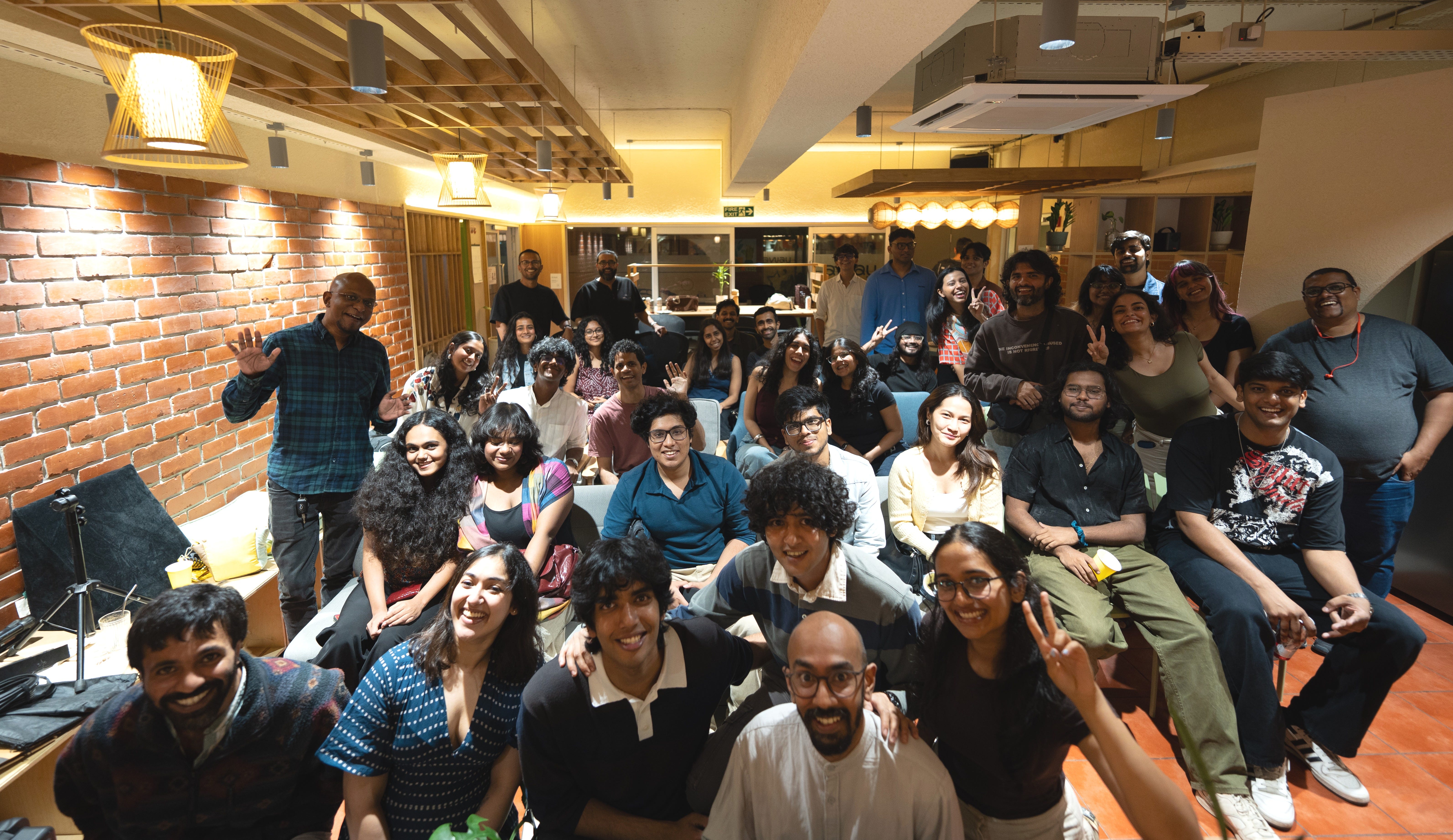
On September 25, Anagha and Hulo joined us for the latest edition of our small, seated live music series. An evening of listening, unwinding, and spending a little time away from the desk.
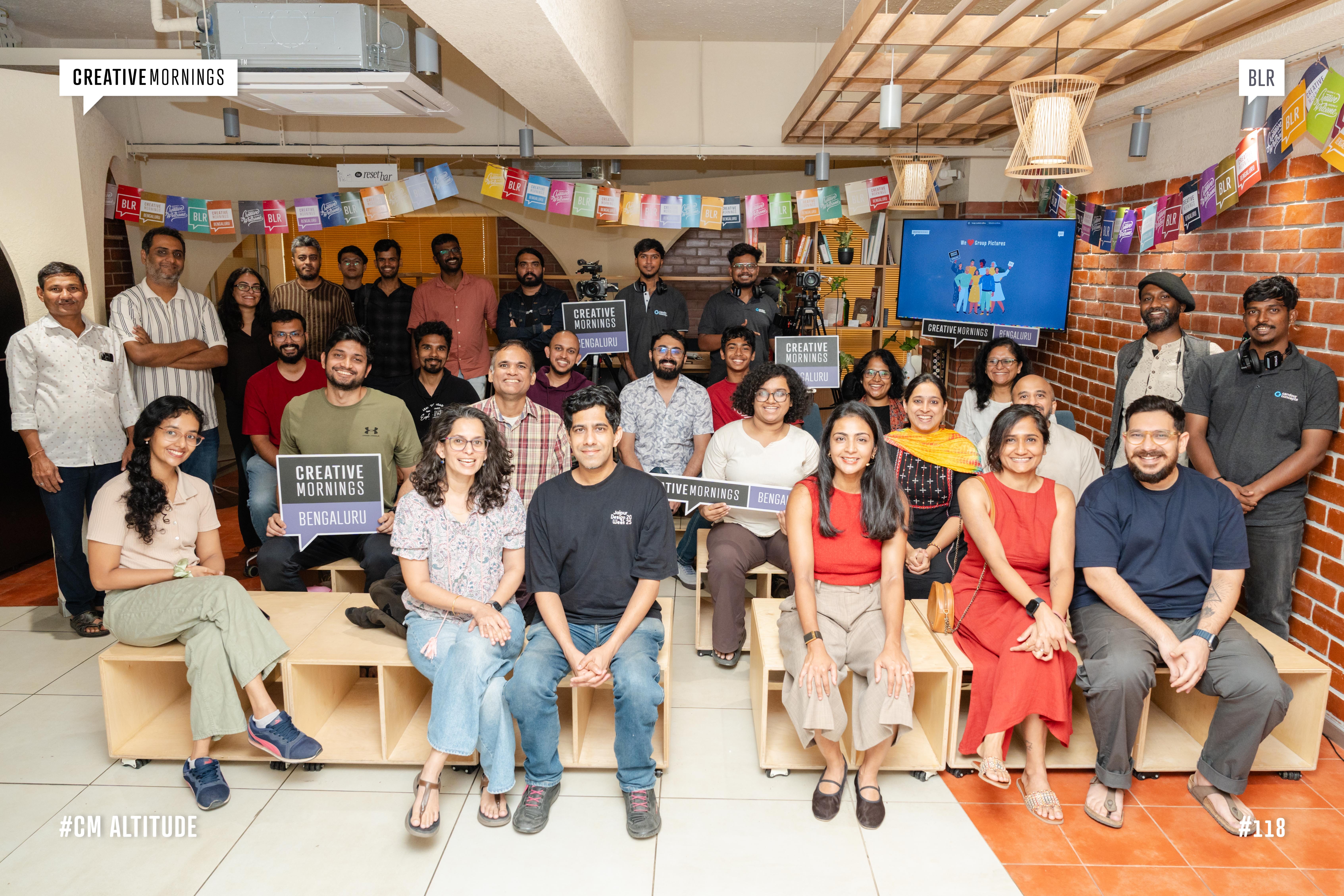
CreativeMornings Bengaluru: Raising the Bar with UNRACK
For CreativeMornings talk #118, we hosted Dr. Sahana Gopal, scientist, weightlifter, coach to Olympians, and founder of UNRACK, an Indian gym equipment brand.She explored the unexpected connections between strength training and manufacturing, and what it took to build precision-engineered weightlifting equipment from the ground up.
Human Library
We hosted the Human Library at away, creating a guided space for meaningful conversations and new perspectives. It was an afternoon of listening, reflecting, and sharing stories at a comfortable pace.
For upcoming events follow- away.center on instagram
From the floor
Meet the people building from away.
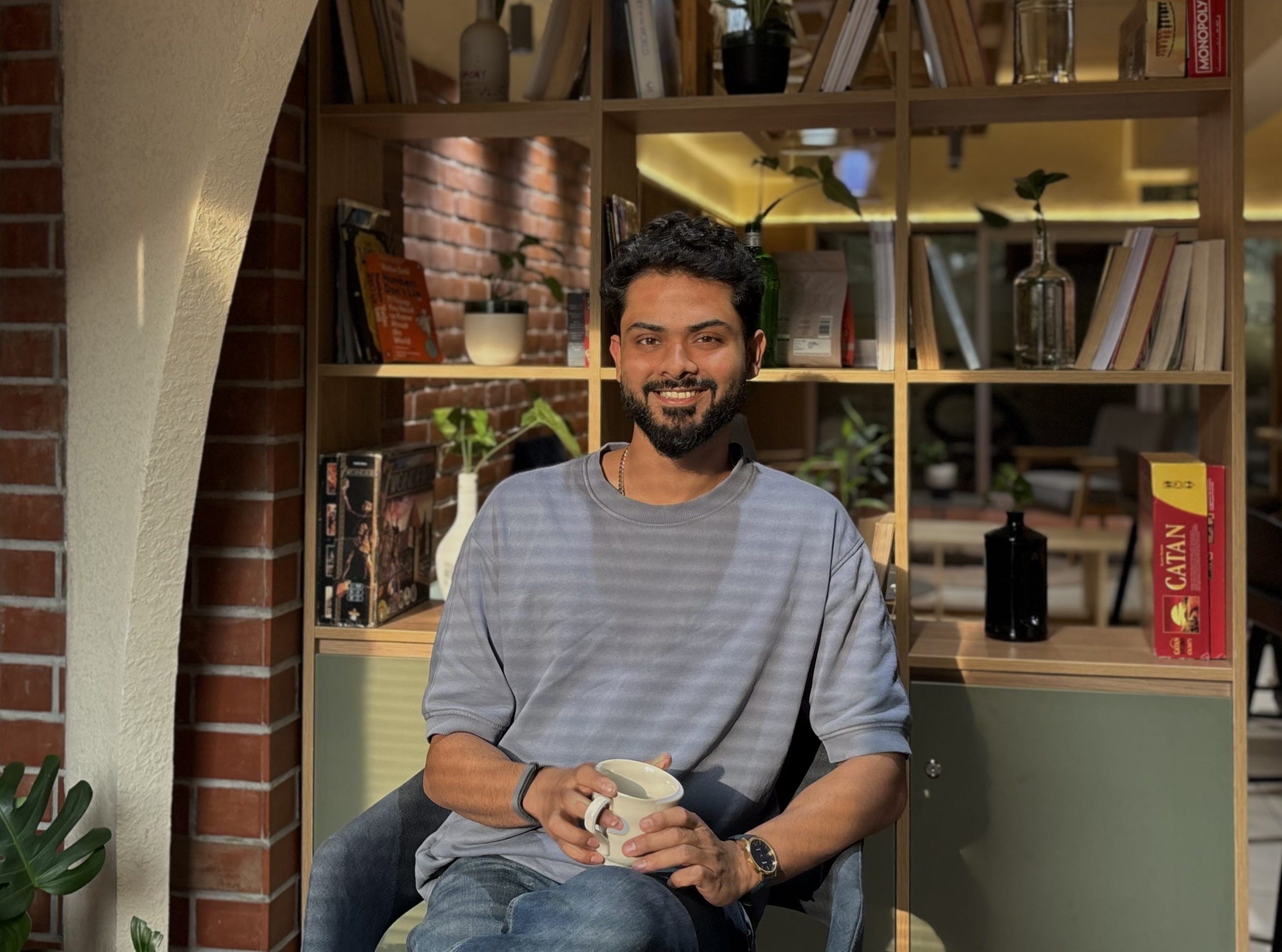
Meet Tanay, founder of Mandrake Bio.
Born and brought up in Assam, Tanay spent his first 25 years in Guwahati before moving to Gurgaon. Eventually, he realized how much a city could shape his life. He began travelling around India, living in different places for a couple of months at a time, before settling in Bangalore.
Mandrake Bio began during what he describes as a quarter-life crisis. With a background in mechanical engineering, Tanay spent six to eight months learning about AI and biology, exploring what he wanted to work on. He experimented with a project at Lossfunk and eventually convinced scientist Dr. Kutubuddin Molla to join him as a scientific co-founder.
That exploration became a company using AI to design medicines from scratch. Outside work, his curiosity takes other forms. He has farmed Bhut Jolokia chillies, become a certified paraglider, and tried rock climbing, salsa, bachata, kayaking, and surfing. Solo travel is another favourite. Sometimes, a couple of days of feeling that he needs a break is enough to get him packing.
Tanay moved his startup into away after walking into the space and feeling at home. What he likes most is the atmosphere, the people, the coffee and the thought behind the small details. For him, it is a place where you can feel the care and soul that went into building it.
Share
Passing Notes - Good things, passed along.
Books, articles, shows, podcasts, and other things our members and team think deserve a little of your time.
A watch from Tanay: Pantheon
Tanay’s recommendation for this edition is the TV series Pantheon.
A book from Udbhav: The Book of Elon by Eric Jorgenson
“I’d recommend this to anyone thinking seriously about what they want to build and how they want to approach their life.
It brings together Elon Musk’s ideas on purpose, first-principles thinking, and the effort required to attempt difficult things. In an increasingly competitive world, there is value in examining how you think, which assumptions you have inherited, and what you are willing to commit yourself to.
For me, the recommendation is about motivation, but also about becoming more deliberate in how we think and act.”
An essay from Udbhav: What Is All of This For?
On AI, human value, and what we might choose to do when greater ability gives us more possibilities than we know what to do with.
About away.center
away.center is a wellness-forward coworking space designed around a simple idea: the environment we work in shapes how we feel and what we create. Natural materials, plants, warm light, and brick replace the usual glass and grey carpet formula. Every detail begins with a question: what makes a space feel good to work from?
Why this newsletter
away Digest is our attempt to put words to the ideas and questions that interest us at away.center. Each edition brings together perspectives on work, creativity, and the way we live, alongside stories from the people sharing our space.
This month, we’re thinking about what happens when intelligence becomes easier to access, work becomes faster to produce, and being capable of doing something no longer tells us whether it is worth doing.
-Take the long way back to your desk.
team away